
Zinc Deficiency in Cotton & Soybean: Symptoms, Causes and How to Correct It
Zinc Deficiency in Cotton & Soybean: Symptoms, Causes and How to Correct It
Zinc deficiency in cotton and soybean is one of the most common micronutrient problems affecting crop productivity worldwide, particularly in regions with alkaline, calcareous, or low-organic-matter soils. Although crops require zinc in relatively small amounts, this essential micronutrient plays a vital role in enzyme activation, chlorophyll production, protein synthesis, hormone regulation, root development, flowering, and seed formation. When zinc is unavailable, cotton plants often produce smaller leaves, shortened internodes, delayed flowering, and poor boll development, while soybean crops exhibit interveinal chlorosis, stunted growth, fewer pods, and reduced seed quality. Even mild zinc deficiency can significantly reduce nutrient uptake efficiency and limit a plant's ability to convert sunlight into energy, ultimately affecting both yield and profitability. In India, where cotton and soybean are cultivated extensively across Maharashtra, Gujarat, Madhya Pradesh, Telangana, Rajasthan, and Karnataka, zinc deficiency has become increasingly common due to continuous cropping, imbalanced fertilizer use, and declining soil health. Early diagnosis and timely correction are therefore essential for maintaining healthy crops and maximizing returns.
Modern agriculture has traditionally focused on nitrogen, phosphorus, and potassium (NPK), but research consistently shows that micronutrients such as zinc are equally important for achieving sustainable, high-yield farming systems. Zinc influences several physiological processes that directly impact crop performance, including auxin production for plant growth, pollen viability, reproductive development, disease resistance, and efficient nutrient transport. Cotton requires sufficient zinc during vegetative growth and square formation to support strong boll retention and superior fibre quality, while soybean depends on zinc for effective nodulation, biological nitrogen fixation, protein synthesis, and oil accumulation. Ignoring zinc nutrition often results in hidden hunger, where plants appear healthy initially but experience substantial yield losses before visible symptoms emerge. This comprehensive guide explains how to identify zinc deficiency in cotton and soybean, understand its underlying causes, choose the most effective correction methods, and implement preventive nutrient management practices that improve crop health, productivity, and long-term soil fertility.
What Is Zinc Deficiency in Cotton and Soybean?
Zinc deficiency in cotton and soybean occurs when plants are unable to absorb enough available zinc from the soil to support normal physiological functions, even if the total zinc content in the soil appears adequate. Zinc is required only in trace amounts, yet it is involved in more than 300 enzyme systems that regulate plant metabolism, growth, and reproduction. It plays a crucial role in chlorophyll formation, protein synthesis, carbohydrate metabolism, hormone production, pollen development, and seed formation. When zinc becomes unavailable because of high soil pH, calcareous soils, excessive phosphorus application, low organic matter, or poor root activity, crop growth slows almost immediately. Cotton plants begin producing smaller, pale green leaves with shortened internodes, while soybean plants develop yellowing between the veins of younger leaves, reduced nodulation, and poor vegetative growth. These symptoms often appear during the early growth stages but can continue throughout the season if left untreated. In many Indian farming regions, zinc deficiency has become one of the leading hidden causes of lower yields because it frequently goes unnoticed until the damage is already affecting boll formation, pod development, and final harvest quality.
Why Is Zinc Essential for Cotton and Soybean?
Zinc supports several critical biological processes that determine crop performance, including:
|
Plant Function |
Importance of Zinc |
|
Photosynthesis |
Supports chlorophyll production and efficient energy conversion |
|
Enzyme Activation |
Activates hundreds of enzymes involved in growth and metabolism |
|
Protein Synthesis |
Essential for amino acid and protein formation |
|
Auxin Production |
Promotes root growth, stem elongation, and leaf expansion |
|
Flowering & Reproduction |
Improves pollen viability, boll retention, and pod formation |
|
Nutrient Uptake |
Enhances absorption and utilization of essential nutrients |
|
Stress Tolerance |
Helps crops withstand drought, heat, and environmental stress |
Why Zinc Is Important for Cotton Crops
Cotton is one of the world's most valuable commercial crops, and achieving high yields with premium fibre quality depends on balanced plant nutrition. While farmers often focus on nitrogen, phosphorus, and potassium (NPK), zinc is an equally important micronutrient that directly influences plant growth, boll formation, fibre development, and overall productivity. Zinc is involved in enzyme activation, chlorophyll synthesis, carbohydrate metabolism, and the production of plant hormones such as auxin, which regulate root growth and stem elongation. Adequate zinc nutrition enables cotton plants to develop a vigorous root system capable of absorbing water and nutrients efficiently throughout the growing season. It also improves photosynthesis, allowing plants to convert sunlight into energy more effectively for vegetative growth and reproductive development. In many cotton-growing regions of India, including Maharashtra, Gujarat, Telangana, Punjab, and Rajasthan, zinc deficiency is increasingly common due to alkaline soils, continuous cotton cultivation, low organic matter, and imbalanced fertilizer application. Addressing zinc deficiency early helps farmers maintain healthy crop growth, improve nutrient use efficiency, and achieve consistent yields even under challenging environmental conditions.
Benefits of Zinc in Cotton
|
Benefit |
Impact on Cotton Crop |
|
Healthy Root Development |
Improves water and nutrient absorption |
|
Enhanced Photosynthesis |
Increases chlorophyll production and plant vigor |
|
Better Square Formation |
Supports early reproductive growth |
|
Higher Boll Retention |
Reduces flower and square shedding |
|
Improved Fibre Quality |
Enhances fibre length, strength, and uniformity |
|
Efficient Nutrient Uptake |
Maximizes the effectiveness of NPK fertilizers |
|
Greater Stress Tolerance |
Improves resistance to drought and heat |
|
Higher Yield Potential |
Produces more bolls and better lint quality |
Why Zinc Is Important for Soybean Crops
Soybean is a nutrient-demanding legume crop that requires a balanced supply of both macronutrients and micronutrients to achieve high yields and superior seed quality. Among the essential micronutrients, zinc (Zn) plays a critical role in supporting early plant establishment, root development, enzyme activation, chlorophyll production, and biological nitrogen fixation. Unlike many cereal crops, soybean depends heavily on healthy root nodules formed by Rhizobium bacteria to convert atmospheric nitrogen into a usable form for plant growth. Zinc is essential for the development and functioning of these nodules, ensuring efficient nitrogen fixation throughout the growing season. When zinc levels are adequate, soybean plants develop stronger roots, produce more branches, maintain dark green foliage, and generate enough energy to support flowering, pod formation, and seed filling. In major soybean-producing states such as Madhya Pradesh, Maharashtra, Rajasthan, Karnataka, and Telangana, zinc deficiency has become increasingly common due to continuous cropping, high soil pH, excessive phosphorus application, and declining organic matter. Early zinc management helps soybean plants remain healthy, resilient, and productive, ultimately improving both crop quality and farm profitability.
Zinc Deficiency Symptoms in Cotton: How to Identify the Problem Early
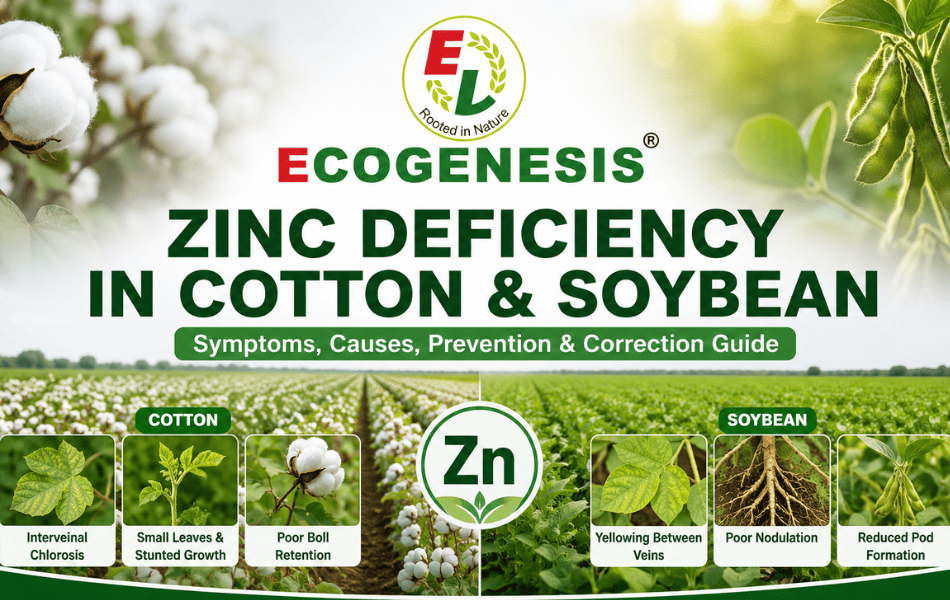
Early identification of zinc deficiency in cotton is essential because visible symptoms often appear only after the crop has already experienced reduced growth and nutrient uptake. Zinc is an immobile micronutrient within the plant, meaning deficiency symptoms first develop on the youngest leaves rather than older foliage. During the initial stages, cotton plants produce leaves that are noticeably smaller than normal, with pale green coloration and interveinal chlorosis—a condition where the tissue between the veins turns yellow while the veins remain green. As the deficiency progresses, plant height decreases because internodes become shorter, giving the crop a compact or rosette-like appearance. Root growth also slows significantly, limiting the plant's ability to absorb water and essential nutrients such as nitrogen, phosphorus, and potassium. Since these early symptoms can resemble other nutrient deficiencies, farmers should confirm the diagnosis through soil testing or leaf tissue analysis whenever possible. Detecting zinc deficiency during the vegetative stage allows timely correction through soil or foliar applications, preventing irreversible losses in boll development and fibre quality.
Zinc Deficiency Soybean Symptoms: How to Identify and Correct Zinc Deficiency Early
Soybean is highly sensitive to micronutrient imbalances, and zinc deficiency soybean symptoms often begin during the early vegetative stage when the crop is rapidly developing roots, leaves, and nitrogen-fixing nodules. Since zinc is relatively immobile within the plant, deficiency symptoms first appear on young leaves, making early scouting essential for timely diagnosis. One of the most recognizable signs is interveinal chlorosis, where the tissue between the leaf veins turns pale yellow while the veins remain green. As the deficiency progresses, newly emerging leaves become smaller, narrower, and slightly distorted, reducing the plant's ability to capture sunlight and produce energy through photosynthesis. Zinc deficiency also limits auxin production, resulting in shorter plants with reduced branching and weaker root systems. More importantly, it affects Rhizobium nodulation, reducing biological nitrogen fixation and causing the crop to rely more heavily on soil nitrogen. In major soybean-growing states such as Madhya Pradesh, Maharashtra, Rajasthan, Karnataka, and Telangana, zinc deficiency is becoming increasingly common due to high soil pH, excessive phosphorus application, low organic matter, and continuous cultivation. Recognizing these symptoms at an early stage enables farmers to apply corrective zinc treatments before pod development and yield are significantly affected.
Cotton vs. Soybean Zinc Deficiency: Key Differences, Similarities, and Field Identification
Although zinc deficiency in cotton and zinc deficiency soybean symptoms share several common characteristics, each crop responds differently because of its unique growth pattern, nutrient requirements, and reproductive biology. In both crops, zinc is an essential micronutrient involved in enzyme activation, chlorophyll production, protein synthesis, auxin (growth hormone) formation, and carbohydrate metabolism. Since zinc is relatively immobile within plants, deficiency symptoms first appear on young leaves, making early scouting particularly important. Cotton typically exhibits smaller leaves, shortened internodes, rosette growth, delayed flowering, and poor boll retention, whereas soybean commonly develops interveinal chlorosis, reduced nodulation, fewer branches, delayed flowering, and poor pod formation. Understanding these differences helps farmers make accurate field diagnoses and avoid confusing zinc deficiency with other micronutrient disorders such as iron, manganese, or magnesium deficiencies. Early identification allows corrective zinc applications before irreversible losses in fibre quality, pod development, or final yield occur.
Main Causes of Zinc Deficiency in Cotton and Soybean
Zinc deficiency in cotton and soybean rarely results from a complete absence of zinc in the soil. In most agricultural fields, zinc is present but becomes chemically unavailable due to unfavorable soil conditions or improper nutrient management practices. This means that even when the soil contains adequate total zinc, plant roots cannot absorb enough of it to support healthy growth. The most common reason is high soil pH, particularly in alkaline and calcareous soils, where zinc reacts with calcium and other minerals to form insoluble compounds. Continuous cultivation without replenishing micronutrients, excessive phosphorus fertilization, low organic matter, poor microbial activity, and irregular irrigation further reduce zinc availability. As a result, cotton plants develop weak roots, delayed flowering, and poor boll formation, while soybean plants experience reduced nodulation, poor pod development, and lower seed quality. Understanding the root causes of zinc deficiency enables farmers to take preventive measures rather than relying solely on corrective treatments after symptoms appear.
How to Confirm Zinc Deficiency in Cotton and Soybean
Correctly diagnosing zinc deficiency in cotton and identifying zinc deficiency soybean symptoms is essential before applying corrective fertilizers. Many nutrient disorders produce similar visual symptoms, making it easy to confuse zinc deficiency with deficiencies of iron, manganese, magnesium, or even nitrogen. Applying the wrong nutrient not only wastes money but can also delay crop recovery and reduce yield potential. While visual observation is the first step in field diagnosis, it should always be supported by soil testing and, where possible, leaf tissue analysis. A combination of these methods provides the most accurate assessment of zinc availability and helps farmers develop an effective nutrient management plan. Early diagnosis is especially important because zinc deficiency affects root development, photosynthesis, flowering, and seed or boll formation long before severe symptoms become visible. By identifying the problem during the early vegetative stage, farmers can take timely corrective action and minimize productivity losses.
How to Correct Zinc Deficiency in Cotton and Soybean
Correcting zinc deficiency in cotton and managing zinc deficiency soybean symptoms requires a combination of timely diagnosis, the right fertilizer source, and proper application methods. The most effective approach depends on the severity of the deficiency, crop growth stage, soil characteristics, and environmental conditions. Soil application is ideal for preventing long-term deficiency and building soil fertility, while foliar sprays provide rapid correction when symptoms are already visible. Fertigation offers another efficient option in irrigated farming systems, ensuring uniform nutrient distribution and improved uptake. Choosing the correct zinc source is equally important. Conventional zinc sulphate remains widely used for soil application, whereas chelated zinc and zinc gluconate offer superior solubility and faster absorption, especially in alkaline or calcareous soils where zinc availability is naturally limited. Early intervention during the vegetative stage prevents irreversible damage to flowering, boll formation, pod development, and seed filling. Farmers who integrate zinc nutrition into their seasonal crop management program consistently achieve higher yields, improved crop quality, and better fertilizer use efficiency.
How to Prevent Zinc Deficiency in Cotton and Soybean
Preventing zinc deficiency in cotton and avoiding zinc deficiency soybean symptoms is far more effective and economical than correcting severe nutrient deficiencies after crop growth has been affected. Zinc plays a vital role throughout the crop lifecycle, from early root establishment to flowering, boll formation, pod development, and seed filling. Once severe deficiency symptoms become visible, some yield and quality losses may already be irreversible. Therefore, successful farmers focus on preventive nutrient management by maintaining adequate soil zinc levels before planting and ensuring continuous zinc availability during critical growth stages. Regular soil testing, balanced fertilization, proper irrigation, and timely micronutrient application are the foundations of an effective zinc management strategy. Fields with a history of zinc deficiency, alkaline soils, or continuous cotton and soybean cultivation require even closer monitoring because these conditions significantly increase the risk of recurring deficiencies. By implementing preventive measures, farmers can improve nutrient uptake efficiency, strengthen crop resilience, and achieve consistently higher yields with better fibre and seed quality.
Frequently Asked Questions (FAQs)
1. What are the first symptoms of zinc deficiency in cotton?
The earliest signs include small young leaves, interveinal chlorosis, shortened internodes, and slow plant growth. If left untreated, the crop develops poor square formation, delayed flowering, and reduced boll retention, leading to lower fibre quality and yield.
2. How can I identify zinc deficiency in soybean?
Soybean plants typically show yellowing between the veins of young leaves, reduced branching, poor nodulation, stunted growth, and delayed flowering. Soil testing and leaf tissue analysis help confirm the diagnosis before applying zinc fertilizers.
3. What causes zinc deficiency in cotton and soybean?
Common causes include high soil pH, calcareous soils, excessive phosphorus fertilizer, low organic matter, sandy soils, poor drainage, and continuous cropping. These conditions reduce zinc availability even when total soil zinc levels are adequate.
4. Which zinc fertilizer is best for cotton and soybean?
The choice depends on soil conditions and application method. Zinc sulphate is widely used for soil application, while chelated zinc and zinc gluconate are effective options for foliar application and improved zinc availability, especially in alkaline soils.
5. Can zinc deficiency reduce crop yield?
Yes. Zinc deficiency reduces photosynthesis, root development, flowering, boll retention in cotton, and pod formation in soybean. Severe deficiency can significantly reduce both crop yield and produce quality if not corrected promptly.
6. When should zinc be applied?
The best time is before deficiency becomes severe. Soil applications are generally made before sowing, while foliar applications are most effective during early vegetative growth and before flowering, depending on crop stage and agronomic recommendations.
7. Is foliar zinc spray effective?
Yes. Foliar zinc sprays provide rapid correction because zinc is absorbed directly through the leaves. They are particularly useful when deficiency symptoms appear during the growing season or when soil conditions limit zinc availability.
8. Can high soil pH cause zinc deficiency?
Yes. In alkaline soils with a pH above 7.5, zinc becomes less available for plant uptake because it forms insoluble compounds. This is one of the most common causes of zinc deficiency in cotton and soybean fields.
9. How often should farmers test their soil?
Most agricultural experts recommend soil testing every 2–3 years, or more frequently in fields with recurring nutrient deficiencies, intensive cropping systems, or significant changes in fertilizer management practices.
10. How can farmers prevent zinc deficiency every season?
Regular soil testing, balanced fertilization, organic matter management, crop scouting, timely zinc application, and integrated nutrient management are the most effective ways to prevent zinc deficiency and maintain healthy, high-yielding crops.
Conclusion
Zinc is a small but indispensable micronutrient that has a profound impact on the growth, productivity, and profitability of both cotton and soybean crops. From promoting healthy root systems and chlorophyll production to supporting flowering, boll development, pod formation, and seed filling, zinc influences nearly every stage of crop development. Unfortunately, zinc deficiency is becoming increasingly common in many agricultural regions due to high soil pH, excessive phosphorus application, low organic matter, and continuous cropping. By recognizing early symptoms, confirming deficiencies through soil and tissue testing, and adopting balanced nutrient management practices, farmers can prevent significant yield losses and improve crop quality. Timely applications of suitable zinc fertilizers—combined with good agronomic practices—help ensure healthier plants, greater nutrient efficiency, and more sustainable farming systems.